FRACTIONAL IT LEADERSHIP

An IT leader without the headcount.

Most companies need someone accountable for IT as a whole — priorities, suppliers, budget and risk. Not all of them need a full-time IT manager. I take on as much of the function as is genuinely needed, and leave a working practice behind.

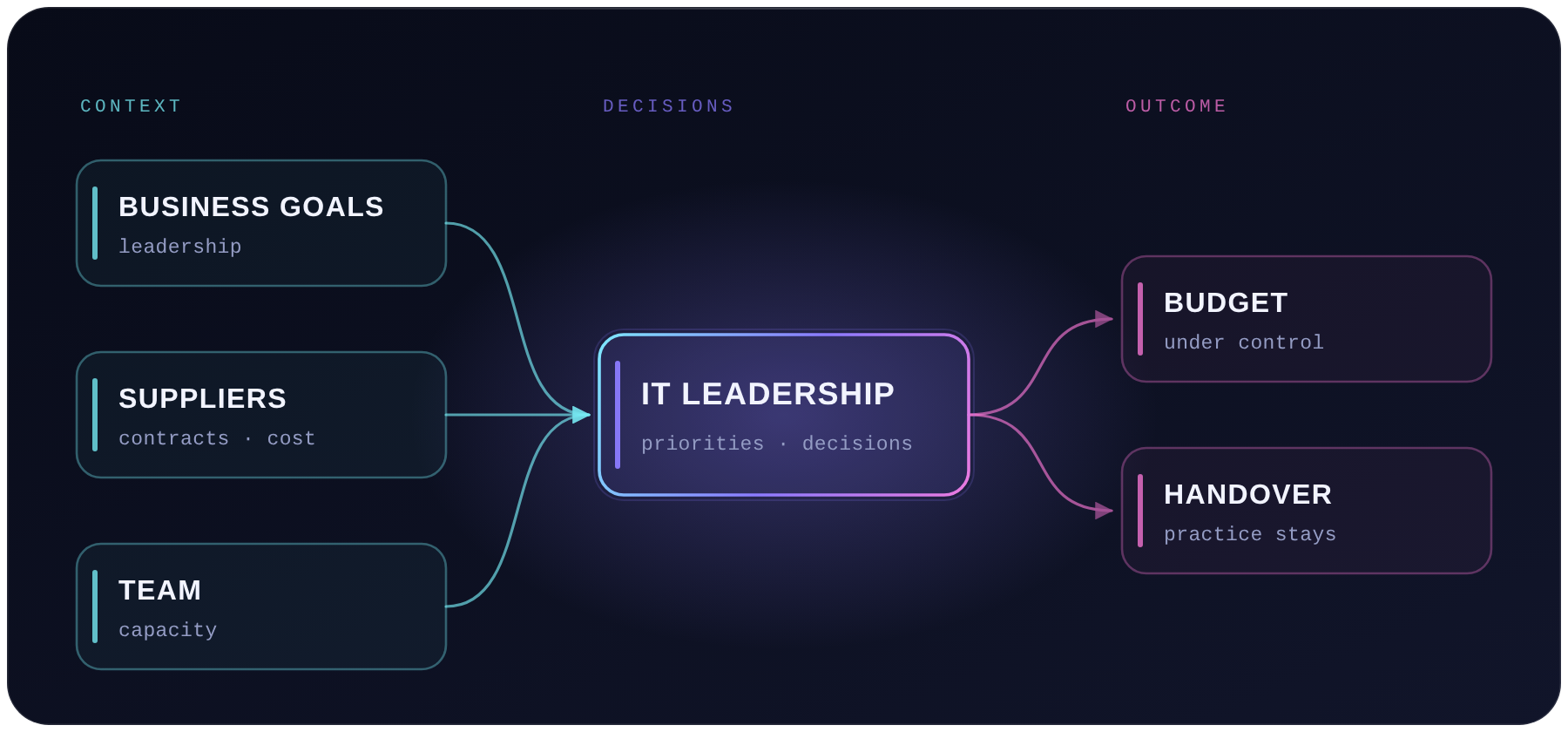
Diagram: business goals, suppliers and team converge on the IT leader, producing a controlled budget and handover

WHEN IT FITS

When you need IT leadership but not a hire.

01

Everyone makes a little of the IT decision.

Management, finance and suppliers each decide separately, so systems do not join up and accountability disappears.

02

Suppliers manage you rather than the reverse.

Invoices grow and contracts renew automatically, but nobody inside assesses whether the service still matches the need.

03

You have engineers but no direction.

The team is technically strong yet works request by request — without priorities, a plan, or a clear link to business goals.

04

The company is outgrowing its IT maturity.

What worked at twenty people creaks at a hundred: access, devices, licences and security stop being manageable by hand.

WHAT YOU GET

Three scopes, sized to how much of the function you need.

01

Interim IT manager

I take the IT leadership function for an agreed period: priorities, suppliers, budget, risk and day-to-day service management. Proven while acting as outsourced IT manager for manufacturing-sector companies.

Deliverable: the function runs day to day instead of waiting on a hire.

02

Fractional IT leadership

An agreed amount of time each month: priority review, supplier management, decisions and direction for the team — without the cost of a permanent hire.

Deliverable: continuous direction, and decisions made on time.

03

Preparing for a permanent hire

We put the function in order, document the processes and prepare the handover so a new IT manager starts from a working base rather than from chaos.

Deliverable: a documented function and a clean handover.

HOW I WORK

Four steps.

A

Establish the state

Services, suppliers, contracts, costs, risks — and who actually makes decisions today.

B

Set priorities

What gets fixed first, by business impact and risk, rather than by who asks loudest.

C

Run it day to day

Priorities, suppliers, incident escalation and budget — reported to management in language they can act on.

D

Hand over control

A documented practice, the decision history and the knowledge to keep the function running without me.

FAQ

Common questions about fractional IT leadership

What is fractional or interim IT leadership?

It is the IT management function bought in the amount you need — a few days a month, or full time for a limited period. You get decision-making, supplier management and direction without paying for a permanent position.

How does this differ from a managed service provider?

A managed service provider handles technical tasks. An IT leader decides which tasks are worth doing at all, how suppliers are managed and where to invest. It is a management function rather than a technical one — often the two work together.

How much time per month is realistic?

It depends on size and maturity. For companies of 20–100 people, a few days a month is usually enough for ongoing management, with a more intensive start while priorities are established.

Would you take responsibility for our existing team?

Yes, where that is needed. The function covers team direction, priorities and how day-to-day work is organised. Personnel decisions remain yours — I provide the assessment and a recommendation.

What happens when the engagement ends?

Handover is part of the service, not an extra. You keep documented processes, the decision history, supplier contracts and a priority plan, so the next person starts from a working base.

OTHER SERVICES

Often addressed together

EXAMPLES

What this looks like in practice

Concrete examples: the situation work starts from, what is done, and what it is judged by.

START HERE

Start with what nobody is managing today.

The most useful first conversation is about which IT decisions in your company currently have no owner at all.