INFRASTRUCTURE & CLOUD

Infrastructure consulting — a decision you can defend.

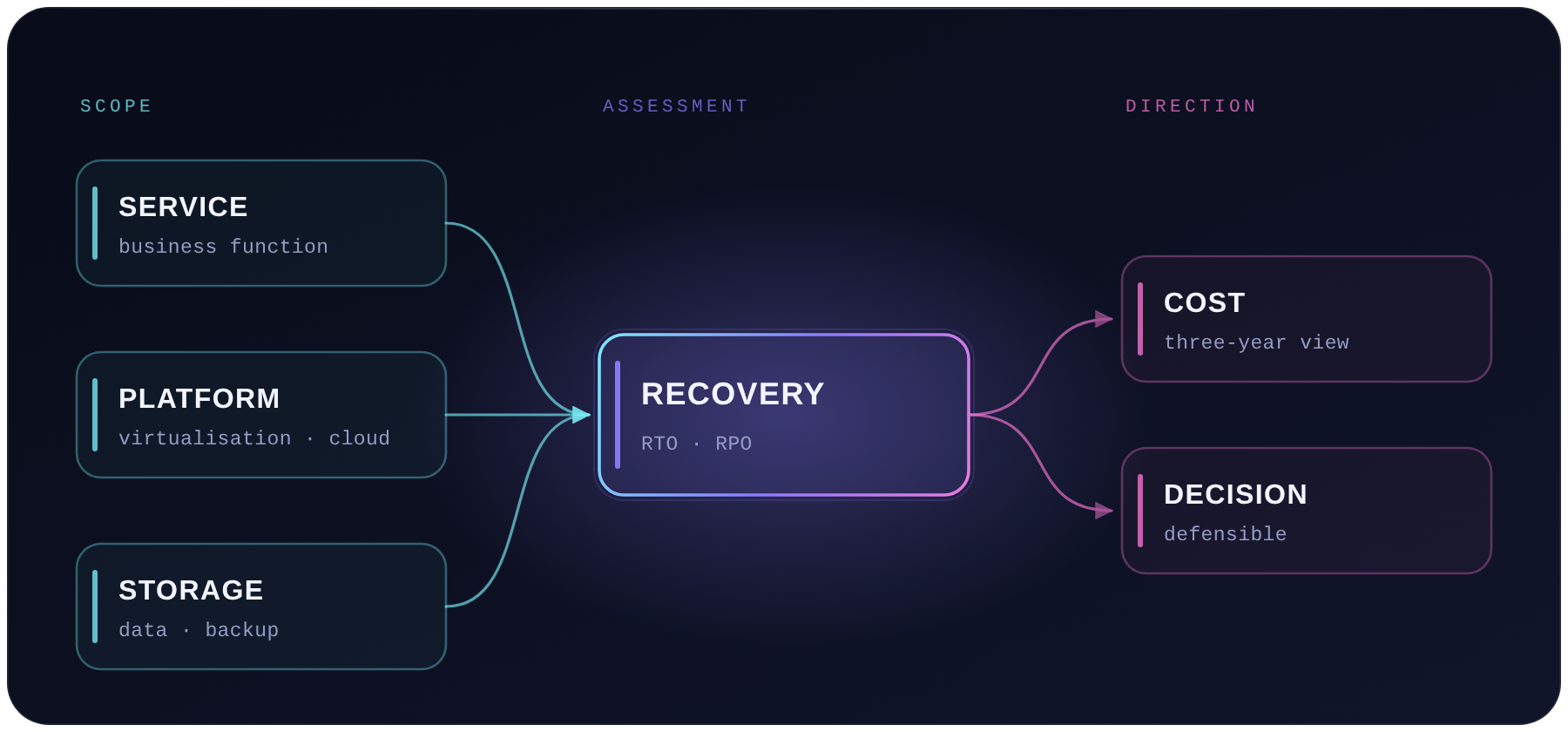
Infrastructure decisions are too often made from a vendor proposal or from whatever is fashionable. We judge differently: how it is operated day to day, how long recovery actually takes, and what it costs across three years.

Diagram: service, platform and storage judged by recovery and cost to reach a defensible decision

WHEN IT FITS

When to pause before buying.

Infrastructure usually needs direction, not another purchase.

01

Hardware is ageing and the decision keeps slipping.

Warranties expire and risk grows, but there is no clear basis for choosing between refresh, cloud or hybrid.

02

Cloud turned out more expensive than expected.

The migration happened, but costs are unpredictable because the architecture moved across unchanged, without revisiting the operating model.

03

Backups run, but recovery has never been tested.

Backup reports success, yet nobody knows how long a critical service would actually take to come back.

04

Every supplier proposes their own architecture.

The proposals cannot be compared because each rests on different assumptions about load, recovery and security.

WHAT YOU GET

From audit to a defensible decision.

01

IT infrastructure audit

We review virtualisation, storage, networking, backup, monitoring and security — assessed not against specifications but against how they behave and recover under real conditions.

Deliverable: a prioritised list of risks and gaps with recommended actions.

02

Cloud and hybrid direction

We assess which services migrate sensibly, which stay put, and what cost logic applies afterwards — AWS, Azure or hybrid.

Deliverable: a reasoned decision with migration and recovery paths, and a cost forecast.

03

Recovery and continuity check

We verify that backups genuinely allow recovery: restore duration, data loss boundary, and dependencies between systems.

Deliverable: real RTO and RPO figures instead of assumptions, with a gap plan.

HOW I WORK

Four steps.

A

Map the foundation

What runs today, the load profile, the dependencies, and the real constraints — budget, skills, deadlines.

B

Lay out the options

Two or three comparable paths with their operating, recovery and cost consequences, rather than one “correct” answer.

C

Test the assumptions

The critical parts get checked in practice — recovery, performance, integrations — while the decision can still change.

D

Hand over control

Documentation, a migration plan and the knowledge your team needs to carry on independently.

FAQ

Common questions about infrastructure and cloud

What does an IT infrastructure audit cover?

Virtualisation, storage, networking, backup, monitoring and security, together with the operating practice around them: who maintains what, how changes are recorded, and how long a critical service takes to recover. You finish with a prioritised risk list, not an inventory spreadsheet.

Is migrating to cloud always worth it?

No. Cloud wins where load varies, speed matters and managed services help. For stable, predictable load, on-premises or hybrid is often cheaper. The decision depends on the load profile, recovery requirements and your team’s skills.

Why did cloud cost more than planned?

Most often because the architecture moved across unchanged: virtual machines run around the clock, storage tiers are unoptimised, data transfer was never modelled. Costs are fixed by revisiting the operating model, not only by negotiating price.

How do we verify that backups actually work?

The only reliable method is a restore test. It establishes how long a system takes to come back (RTO) and how much data is lost (RPO), including dependencies on other systems. “Backup successful” guarantees nothing.

Do you work with specific vendors?

I have run the mainstream virtualisation, storage, backup, networking, security and public cloud platforms in production. Recommendations are not backed by any partnership — I am not a reseller and earn nothing from the sale.

OTHER SERVICES

Often addressed together

EXAMPLES

What this looks like in practice

Concrete examples: the situation work starts from, what is done, and what it is judged by.

START HERE

Bring the decision that keeps slipping.

The most useful first conversation is about one specific choice that never quite gets made, or a risk that keeps you uneasy.