01
IT Service Management (ITSM)
Incident and problem management, SLAs, escalation and clear ownership. When daily service becomes predictable, your team can build instead of firefight.
SERVICES
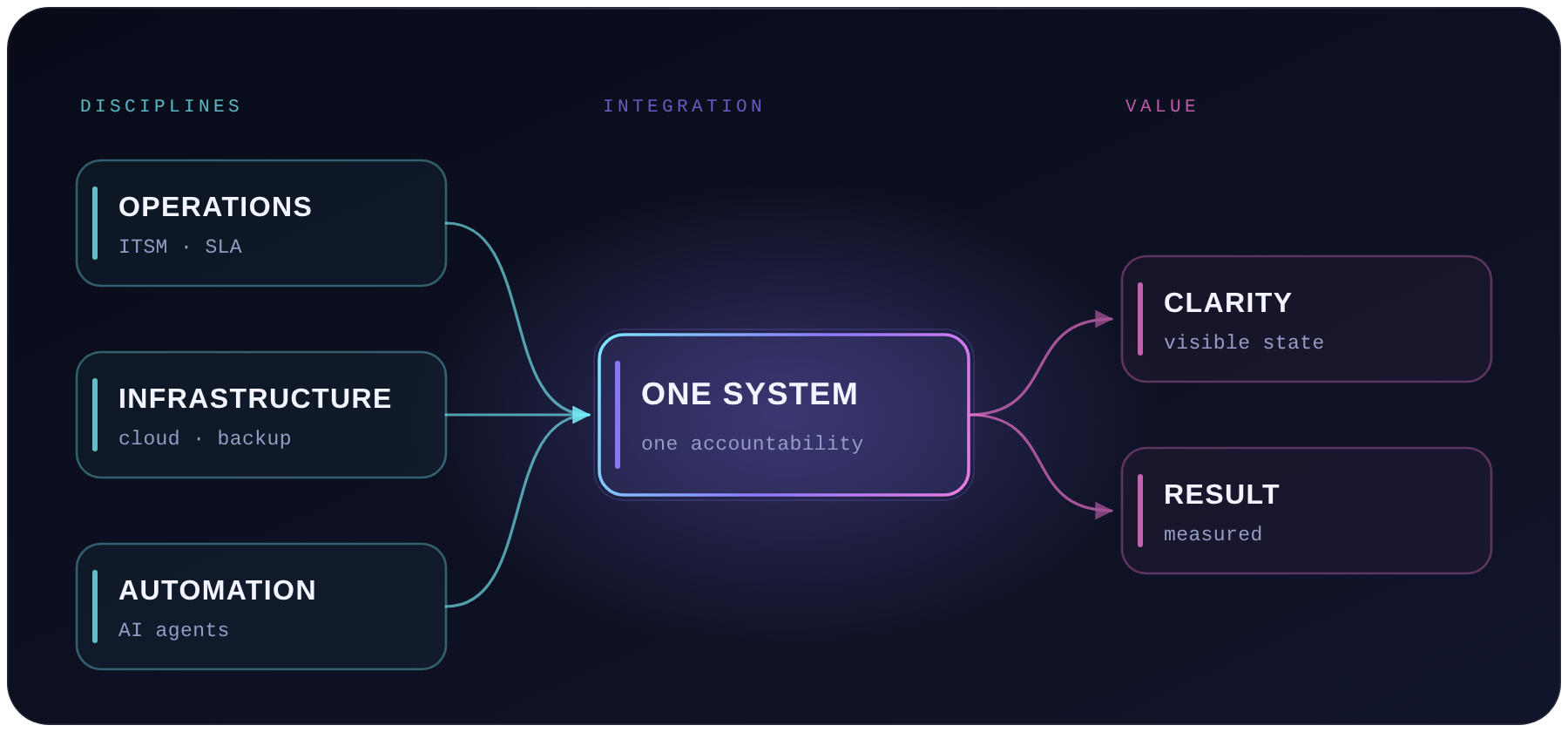
Most problems labelled “IT” are a seam between operations, infrastructure and automation. Each service has a defined scope, a timeframe and a deliverable you can use even if you decide not to continue.
HOW I CAN HELP
Most engagements start with one — whichever is causing the most trouble today.
01
Incident and problem management, SLAs, escalation and clear ownership. When daily service becomes predictable, your team can build instead of firefight.
02
Virtualisation, storage, backup, networking, security and cloud. Judged by how it operates, recovers and costs.
03
One real workflow automated end to end — with human oversight, safe boundaries and a measurable result.
04
A fractional or interim IT manager for companies that need the function but not a full-time hire. Priorities, suppliers, budget and handover.
FAQ
Whichever is causing the most trouble today. If incidents repeat, start with service management. If an infrastructure decision keeps slipping, start with the audit. If the team is drowning in manual work, start with automation. A first conversation usually settles it.
Yes. Some services — fractional IT leadership in particular — exist precisely for organisations without their own IT manager. Scope is matched to size and maturity.
Yes, and usually you should. A fixed-scope assessment or a single pilot produces a concrete result and lets you judge the working relationship before committing further.
No. I earn nothing from selling hardware or licences, so recommendations do not depend on partnerships. That matters most when you need someone to assess supplier proposals.
EXAMPLES
Concrete examples: the situation work starts from, what is done, and what it is judged by.
START HERE
A short conversation about context usually shows which service is actually needed — and sometimes that none is, yet.