01
IT service assessment
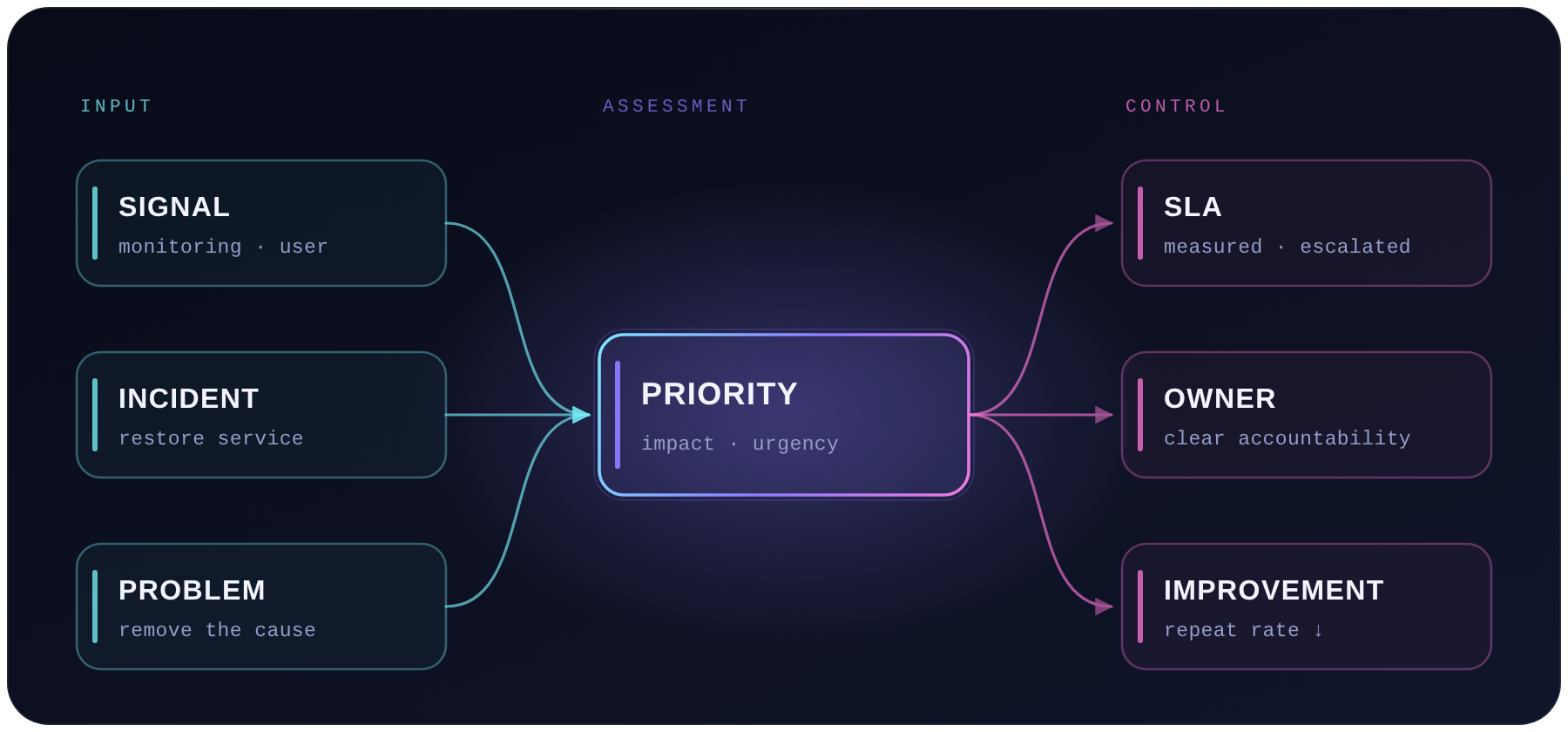
A fixed-scope review: ITSM practice, incident and problem flow, SLAs, escalation paths, prioritisation logic and who actually owns what.
Deliverable: a prioritised improvement plan with owners, effort and expected impact.
IT SERVICE MANAGEMENT
When incidents repeat, SLAs drift away from what the business expects and ownership disappears between teams and suppliers, the problem is rarely the tool. We clarify what is genuinely measured, where accountability vanishes, and which decision has to be made.
WHEN TO CALL
Not every problem needs a new system. Most need clarity about who owns what.
01
Symptoms get cleared quickly, but with no problem management practice the same failure returns a month later.
02
Metrics are calculated but disconnected from decisions: it is unclear who acts when a threshold is breached, or what changes as a result.
03
When one engineer is away the process stops. Knowledge lives in heads rather than runbooks.
04
Each supplier delivers their part, while the service as a whole has no owner.
WHAT YOU GET
You can start with one stage and stop — each produces a result on its own.
01
A fixed-scope review: ITSM practice, incident and problem flow, SLAs, escalation paths, prioritisation logic and who actually owns what.
Deliverable: a prioritised improvement plan with owners, effort and expected impact.
02
We clarify what is measured and why, align the metrics with business expectations, and connect them to concrete decisions and escalation.
Deliverable: a set of SLAs both IT and the business understand, with a clear response procedure.
03
Acting service delivery lead for organisations that need the function but not a full-time hire — proven while running services for multiple clients.
Deliverable: the function runs day to day, the practice is built and handed over.
HOW I WORK
A
Business goal, service catalogue, teams, suppliers, risks and the real constraints — without assumptions.
B
Priorities, ownership, escalation procedure, metrics and a way back if something goes wrong.
C
The practice is tested against real incidents, not in a spreadsheet: we measure whether resolution time and quality actually change.
D
Documentation, runbooks and the knowledge your team needs to operate independently.
FAQ
ITSM treats IT as services with clear owners, metrics and procedure, rather than as a stream of failures. Not everyone needs formal ITSM, but every organisation that depends on IT needs clarity about ownership and escalation.
Usually not. Most problems come from unclear ownership, priorities and escalation rather than from the tool. We fix the practice first; only then is it clear whether the existing systems are genuinely insufficient.
Incident management restores the service as fast as possible. Problem management finds the cause so the incident stops recurring. Organisations with only the first fight the same fires for years.
A meaningful SLA is tied to a business consequence and has an owner who acts when it is breached. If a metric is measured but nobody changes behaviour when it fails, it is a report, not an agreement.
A fixed-scope assessment usually runs a few weeks, depending on the number of services and how quickly people and data are available. You finish with a prioritised plan, not a general audit.
Yes. That experience includes delivering services under formal procurement, and managing scope and budget under those conditions.
OTHER SERVICES
EXAMPLES
Concrete examples: the situation work starts from, what is done, and what it is judged by.
START HERE
The most useful first conversation is about what is actually going wrong: repeated incidents, drifting SLAs, or ownership nobody will take.