AI AGENTS & AUTOMATION

AI agents for business — from demo to a process that runs.

AI adoption rarely stalls on the model. It stalls on the process: which workflow to automate, who stays accountable, and how the result is measured. We start from one concrete workflow and finish it.

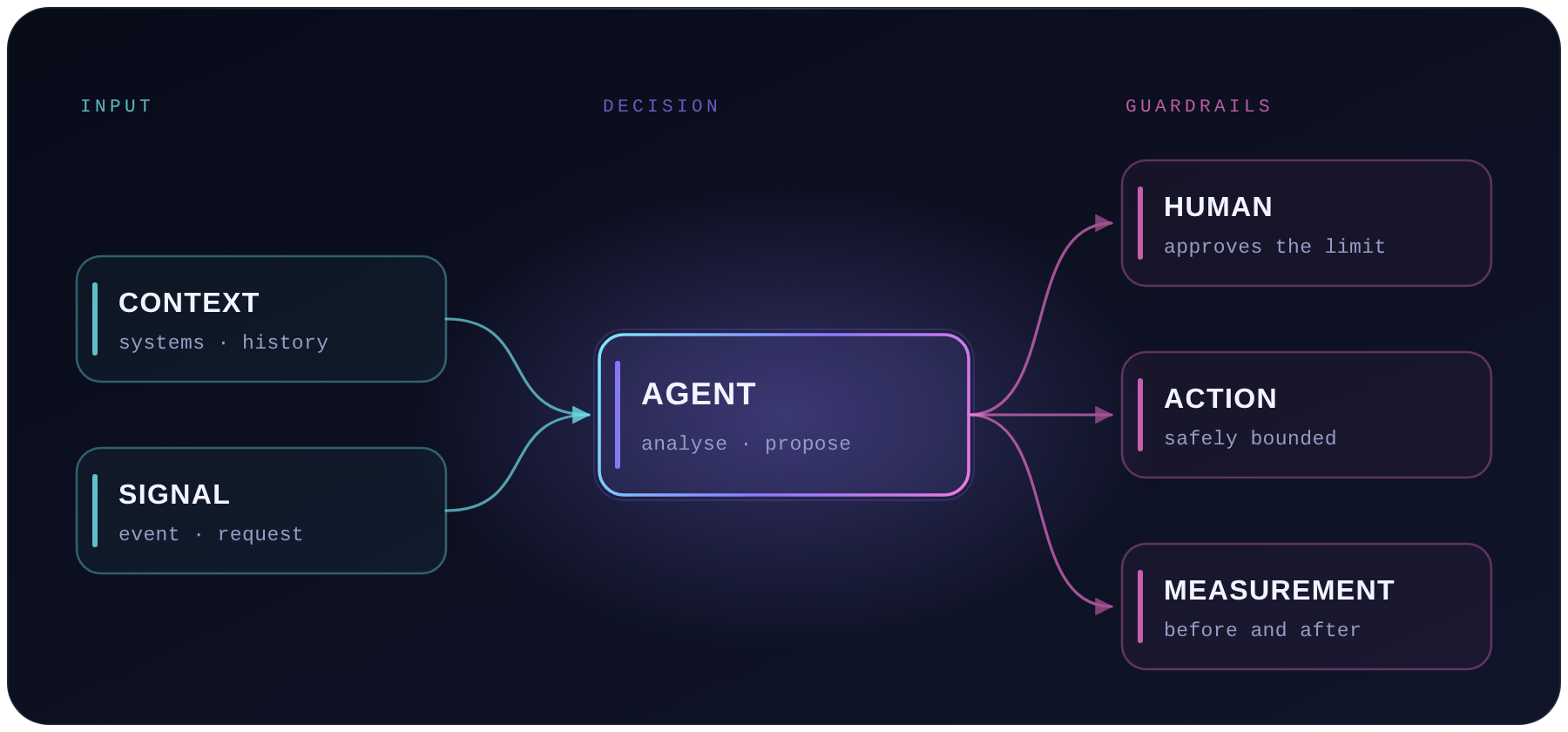
Diagram: context and signal enter the agent, which proposes an action; a human approves the edge and the result is measured

WHEN IT FITS

When AI agents earn their place.

Not every process needs AI. These signs suggest it is worth a serious look.

01

Your team repeats the same manual work every day.

Pulling data from several systems, preparing reports, triaging incoming requests — work that costs time but needs no judgement.

02

The information exists, but decisions still lag.

Signals arrive from monitoring, ITSM and email, but hours pass before anyone joins them into a single picture.

03

You tried AI and it stayed a demo.

The pilot worked in the presentation and never reached production, because boundaries, integrations and ownership were missing.

04

You need automation you can actually trust.

Decisions touch customers or money, so you need auditable actions, explicit limits and human approval at the risky edge.

WHAT YOU GET

Three scoped steps.

Each stage ends with something you can judge and use, even if you decide not to continue.

01

Process review and candidate assessment

We review your workflows and select the ones worth automating — by volume, repetition, cost of error and data availability.

Deliverable: a prioritised list of processes with an assessment and a recommended starting point.

02

Pilot on one real workflow

One process automated end to end: integrations, agent logic, safe boundaries, human approval points and instrumentation.

Deliverable: a working pilot in the production environment and the data to decide about scaling.

03

Handover and expansion

Documentation, team enablement and a plan for applying the same model to other processes without outside help.

Deliverable: a team that owns the solution, and a clear path to expand.

HOW I WORK

Four steps, no presentation fog.

A

Map the process

Who runs it today, how long it takes, where it goes wrong, and what data is genuinely available.

B

Set the boundaries

What the agent may do alone, where human approval is required, and how every action is recorded.

C

Ship it and measure

A pilot in the real environment with explicit metrics: time saved, error rate, handling time.

D

Hand over control

Documentation, runbooks and the knowledge your team needs to carry on without me.

FAQ

Common questions about AI agents in business

What is an AI agent, and how does it differ from ordinary automation?

Ordinary automation executes a predefined sequence of rules. An AI agent also gathers context, assesses the situation and proposes or takes an action against a goal rather than a fixed script. In practice the best result is a combination: rules where rules suffice, an agent where judgement is needed.

Where should we start with AI adoption?

With one concrete process that repeats, costs real time and has a clear outcome. Broad “AI strategy” projects usually end as documents. One finished process delivers both value and the experience to expand from.

Are AI agents safe if the process touches customer data?

Safety here is a question of constraints. The agent gets specific permissions, accessible data and allowed actions; risky steps require human approval; every action is logged. Where data is processed, and which model is used, are agreed against your requirements.

How long does a pilot take?

A single-workflow pilot typically runs from a few weeks to a couple of months, depending on how many integrations are involved and how quickly data and decision-makers are available.

How is the benefit measured?

We record the current state before starting: how long the process takes, how often it repeats, how many errors occur. After the pilot we compare the same figures. If they do not improve, that is also a result — and a far cheaper one than a broad rollout.

Do we need to replace our existing systems?

Usually not. Agents connect to what already works — ITSM, monitoring, email, databases — through existing interfaces. Replacing a system is considered only when integration is otherwise impossible.

OTHER SERVICES

Often addressed together

EXAMPLES

What this looks like in practice

Concrete examples: the situation work starts from, what is done, and what it is judged by.

START HERE

Bring a process, not a technology.

The most useful first conversation is about one specific workflow that costs too much time. That alone shows whether AI agents are the right answer here.